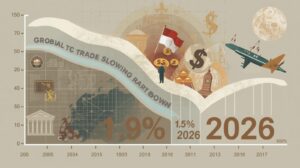
Global trade growth may slow to ~1.9% in 2026. Central banks remain cautious amid persistent inflation and rising geopolitical risks.
Global economic momentum is expected to moderate in 2026 as stubborn inflation and ongoing geopolitical tensions continue to weigh on growth prospects. According to projections from organizations like the International Monetary Fund, global trade expansion could slow to approximately 1.9%, signaling a more cautious phase for the world economy after years of uneven recovery.
Despite aggressive monetary tightening over the past two years, inflation remains above target levels in several major economies. While headline inflation has eased in some regions, core inflation—driven by services and wage pressures—continues to challenge policymakers. This has led central banks, including the Federal Reserve and the European Central Bank, to maintain a cautious stance on interest rate cuts.
“Premature easing could risk reigniting inflationary pressures,” noted analysts, emphasizing that central banks are now prioritizing long-term stability over short-term growth boosts.
Adding to the economic uncertainty are escalating geopolitical risks. Ongoing conflicts, trade fragmentation, and shifting alliances are disrupting supply chains and dampening investor confidence. Strategic competition among major economies has also contributed to a more protectionist global trade environment, further slowing cross-border activity.
Emerging markets, while showing pockets of resilience, are particularly vulnerable to these global headwinds. Currency volatility, higher borrowing costs, and reduced capital inflows could strain economic stability in several developing nations.
At the same time, structural challenges—including aging populations in advanced economies and uneven digital transformation—are adding pressure to long-term growth potential. Businesses are responding by tightening investment strategies and focusing on efficiency rather than expansion.
However, not all signals are negative. Technological innovation, particularly in artificial intelligence and green energy, continues to offer growth opportunities. Governments investing in infrastructure and sustainability may help cushion the slowdown and lay the groundwork for future expansion.
Looking ahead, economists suggest that coordinated global policy efforts will be crucial to navigating this uncertain landscape. Balancing inflation control with growth support remains a delicate task, one that will define the trajectory of the global economy in the coming years.
As 2026 unfolds, the world economy appears set for slower—but not stalled—growth, with resilience hinging on policy discipline, geopolitical stability, and the ability to adapt to a rapidly evolving economic environment.