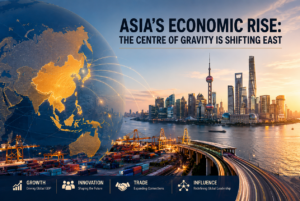
One of the most important business stories of 2026 is the accelerating rise of Asia as a global economic powerhouse.
For years Asia was recognised primarily as the world’s manufacturing centre. Today, it has evolved far beyond that identity.
It is now a leader in innovation, capital formation, entrepreneurship, digital commerce, fintech, healthcare, artificial intelligence and consumer growth.
Asia is no longer simply participating in global business—it is increasingly shaping it.
The numbers tell part of the story, but the transformation is visible on the ground as well.
Cities such as Singapore, Mumbai, Bengaluru, Jakarta, Ho Chi Minh City and Seoul are becoming central hubs for global investment and business strategy.
India remains one of the strongest examples of this momentum.
Driven by digital infrastructure, rapid startup growth, manufacturing expansion, consumer demand and technological innovation, India continues to attract global capital across sectors.
Its combination of scale, youthful population and digital acceleration makes it one of the most closely watched economies in the world.
Singapore remains a key gateway for international capital and corporate headquarters in Asia.
Its financial infrastructure, regulatory strength and innovation ecosystem continue to attract multinational firms from around the globe.
Southeast Asia is also emerging rapidly as a strategic manufacturing and consumer market.
Global corporations are expanding across Vietnam, Indonesia, Thailand and Malaysia as supply chains become more diversified.
Meanwhile, China remains a dominant force in production, exports, EV innovation and industrial scale, even amid evolving economic adjustments.
Asia’s rise is not a temporary trend.
It reflects a deeper rebalancing of global economic power.
Business leaders worldwide increasingly understand that future growth strategies cannot ignore Asia.
The next decade of global commerce will be shaped significantly by decisions made across the region.