





A World on Edge: Why the Iran–Israel tensions Demand Urgent Global Restraint
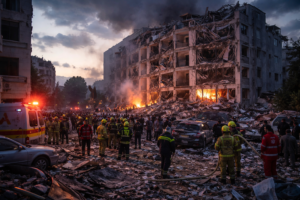
A World on Edge: Why the Iran–Israel tensions Demand Urgent Global Restraint
March 2026
The latest escalation between Iran and Israel is not just another chapter in a long-standing rivalry—it is a stark warning that the world may be drifting dangerously close to a broader, uncontrollable conflict. What began as a series of calculated strategic strikes has now evolved into a volatile cycle of retaliation, where each move risks triggering consequences far beyond the region.
At the heart of this crisis lies a troubling reality: both sides are operating under doctrines of deterrence that increasingly resemble provocation. Missile strikes near sensitive zones, particularly around facilities like Dimona Nuclear Facility and Natanz Nuclear Facility, are not merely tactical—they are symbolic escalations. They signal a willingness to test red lines that, until recently, remained largely respected.
This is where the danger multiplies.
The Illusion of Controlled Escalation
History has repeatedly shown that conflicts framed as “limited” or “controlled” rarely remain so. The belief that precision strikes and strategic messaging can contain violence is, at best, optimistic—and at worst, dangerously naïve. In a region as complex as the Middle East, where alliances are fluid and proxy actors are deeply embedded, escalation is rarely linear.
What makes the current situation particularly alarming is the convergence of multiple high-risk variables: advanced missile capabilities, cyber warfare potential, and the proximity of military actions to nuclear infrastructure. Even a minor miscalculation—an intercepted missile failing, a misidentified target, or an overreaction by allied forces—could trigger a chain reaction with irreversible consequences.
Global Stakes, Shared Consequences
While the conflict is geographically concentrated, its implications are undeniably global. Energy markets have already begun to react, with instability around key routes like the Strait of Hormuz threatening supply chains and economic stability worldwide.
Moreover, the increasing involvement of global powers, particularly the United States, raises the stakes significantly. What may appear as a regional conflict could quickly transform into a multi-front geopolitical crisis, drawing in allies and adversaries alike.
The modern global order—interconnected, interdependent, and already strained—cannot afford another prolonged conflict of this magnitude.
The Cost of Silence and Inaction
Perhaps the most concerning aspect of the current crisis is not just the escalation itself, but the relative absence of effective diplomatic intervention. While international bodies have issued calls for restraint, these statements risk becoming routine rather than impactful.
Silence, or worse, passive observation, can be interpreted as tacit acceptance.
The global community must move beyond symbolic diplomacy. This moment demands proactive engagement—backchannel negotiations, multilateral pressure, and a renewed commitment to de-escalation frameworks. Without it, the window for peaceful resolution may close faster than anticipated.
A Test of Leadership
Ultimately, this crisis is not just about Iran or Israel. It is a test of global leadership.
Will world powers act decisively to prevent escalation, or will they allow strategic interests and political calculations to dictate a path toward conflict? The answer will define not only the outcome of this confrontation but also the credibility of international diplomacy in an increasingly fragmented world.
Conclusion: Choosing Restraint Over Ruin
The trajectory of the Iran–Israel tensions serves as a sobering reminder that in an era of advanced warfare, the margin for error is dangerously thin. Restraint is no longer a moral choice—it is a strategic necessity.
The world stands at a crossroads. One path leads to escalation, uncertainty, and potential catastrophe. The other requires courage, compromise, and a willingness to step back from the brink.
The question is not whether the stakes are high—they are.
The question is whether global leaders will act before it is too late.