A New Economic Era Takes Shape
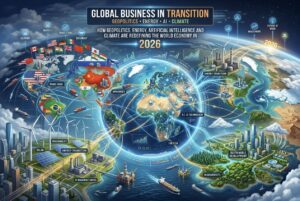
The global business environment in 2026 is being shaped by forces more interconnected, complex and transformative than ever before. Markets are no longer influenced solely by earnings reports, interest rates or trade performance. Today, boardrooms and investors are making decisions at the intersection of geopolitics, artificial intelligence, climate risk, energy security and rapidly shifting consumer behaviour.
Across every region of the world, business leaders are navigating a landscape where change is constant and certainty is increasingly rare. Yet within that uncertainty lies extraordinary opportunity.
The world economy is entering a new chapter—one defined not merely by recovery or growth, but by reinvention.
Companies are rebuilding supply chains, investors are reallocating capital, governments are rewriting industrial policies and entrepreneurs are creating solutions for challenges that did not exist a decade ago. Traditional business models are being questioned. New economic alliances are emerging. And the very definition of leadership is evolving.
In many ways, 2026 represents a turning point. It is a year in which global business is moving from reaction to transformation.
This transformation is not happening in one sector or one country alone. It is visible everywhere—from Wall Street to Singapore, from the energy markets of the Middle East to technology hubs in India, Europe and Silicon Valley.
The global economy is becoming more decentralised, more digital and more deeply shaped by global events than ever before.
To understand where business is headed next, it is important to examine the forces driving this shift.